Scandinavia
Scandinavia is Denmark, Norway, Sweden
Two notions must be kept distinct: "Scandinavia" and the "Scandinavian Peninsula". They are not the same, and the former is not derived from the latter, on the contrary. "The Scandinavian Peninsula" does not mean "the peninsula that constitutes Scandinavia"; it means the peninsula that is lying in the political-cultural area called "Scandinavia".
It is easier to understand, if we take a parallel but better known example. Saying "America" meaning the "United States of America", the term corresponds to "Scandinavia", saying "America" in the sense of the "continents of North and South America" the term corresponds to the "Scandinavian Peninsula" (only that in the case of America, the geographical term "North and South America" is the more comprehensive, while in our case the cultural term "Scandinavia" is the more comprehensive). ¹
I don't see why people outside Scandinavia and Finland should convince themselves of a use of the word "Scandinavia" contrary to the meaning that the inhabitants of Scandinavia itself (and Finland) attribute to that word. And in opposition to the historical, political and cultural facts.
The Scots are not English. But they are British. If somebody happens to have a tradition of saying that the Scots are English, it will nonetheless remain wrong. Somebody could say that Mexico is part of the USA. If it happens to become a tradition in some nation to say so, it will still not be true.
Said in a simple way: "Scandinavia" is a cultural term, not plainly geographical, and consists of the three countries Denmark, Norway and Sweden. "The Scandinavian Peninsula" means the peninsula lying between Finland and Denmark, practically it is coextensive with the two countries of Norway and Sweden (and the North-Western part of Finland); but, of course, "Norway" and "Sweden" are cultural concepts, not geographical ones.
The three Scandinavian peoples
The Scandinavian peoples are the Danes, the Norwegians and the Swedes. They have much in common, history, language (their languages can be considered dialects of the same language, "Scandinavian") and culture in general. The Vikings were Danes, Norwegians and Swedes - and only them. From the beginning the three peoples have always been friends and enemies. Their kingdoms were often in war each one trying to expand itself, they made alliances, confederations and unions. Denmark and Sweden, more than Norway, would search for supremacy in Scandinavia.
The fact that some people insist of talking of Scandinavia as Norway + Sweden + Finland (excluding Denmark) can be excused, because it is based on a profound ignorance. These people should know that Denmark until about 1658 was the leading Scandinavian country. The three countries were united, for the first and only time, by the Danish Queen Margaret, a union that lasted from 1397 to 1521. Denmark and Norway remained united under the Danish kings from 1380 to 1814. Until 1658 Denmark was generally the strongest state, but from that period Sweden took the lead. The region of Skåne (nowadays the most Southern region of Sweden) has probably given its name to the whole of Scandinavia. Skåne is now Swedish, but until 1658 it was a Danish region.
Finland, from a Swedish "colony" to an indipendent nation
Finland is not Scandinavian, and never was. In the English-speaking world, and not only, unfortunely, "Finland is widely referred to as Scandinavian ", even in a famous work as Funk & Wagnall's Practical Standard Dictionary, 1924 ². But, that does not mean that this is the truth. In Denmark, Norway and Sweden people know that Scandinavia consists of those three countries, from the beginning of their history; nobody in those countries will tell you that Finland is Scandinavian. In Finland itself, people know their own history and they don't consider themselves Scandinavian. The Finnish are proud of being Finnish, they don't want to be Scandinavian. They are important friends of the Danish-Norwegian-Swedish peoples, and from a certain time they have become "aggregated" to Scandinavia and to the Scandinavian social model. That is why there came about a need for another term indicating the unified whole of Scandinavia and Finland. In the area, we call it the Nordic Countries. Geologists sometimes talk about Finno-Scandinavia or Fennoscandia, indicating by that the geographical area consistent of the Scandinavian Peninsula and the territory occupied by the republic of Finland (excluding Denmark). That has obviously nothing to do with the cultural and historical idea of Scandinavia = Denmark+Norway+Sweden .
In the period from 1238 to 1323 Finland became annexed into Sweden and lasted so until 1809, when, after a war, Finland was surrendered to the Russian Zar. Formerly it remained an autonomous "grand duchy", until 1917. During the 5-6 centuries under Sweden, first simply as Swedish regions, then as a duchy, later "grand duchy", Finland was enormously influenced by Swedish culture. Now approximately 5,4% of the Finns has Swedish as their mother tongue, but the other 90% generally don't speak Swedish. They learn Swedish three years in school, but their level of fluency varies much. (Funny enough, you might say that Finland, from 1323 to 1809, being formally part of Sweden, in that period was on the way of becoming Scandinavian. But later they realised their own original nature as a nation different from the Scandinavians.)
Many features bind Finns to the three Scandinavian nations. The idea of a welfare society, including the educational system, is largely the same, Finland being part of Sweden for centuries has adopted many aspects of the Scandinavian culture. On the other hand, the Finnish people has developed a strong conciousness of the historical and ethnical differences between them and the Scandinavians, the linguistic difference being the most visible element: Danes, Norwegians and Swedes more or less understand each other, their languages being almost dialects of the same language, while Finnish is completely unintelligible to Scandinavians, unless they have studied the language.
A few examples of words in Norwegian-Danish-Swedish, Finnish and Sami
| Danish | Swedish | Norwegian | Finnish | Samish | |
| 1 | en | en | en, ein | yksi | okta |
| 2 | to | två | to | kaksi | guokte |
| 3 | tre | tre | tre | kolme | golbma |
| 4 | fire | fyra | fire | neljä | njeallje |
| 5 | fem | fem | fem | viisi | vihtta |
| 6 | seks | sex | seks | kuusi | guhtta |
| fader | fader | fader | isä | ahhči | |
| moder | moder | moder | äiti | ean?ni | |
| broder | broder | broder | veli | viéllja | |
| søster | syster | søster, syster | sisar, sisko | oabbaa |
Two short notes.
a) Finnish sisar, sisko is a loan from an indoeuropean language.
b) Samish, a parent language of Finnish, spoken in the North of Finland, has obvious likeness with Finnish in the numerals 1 to 6, though there are many differences. However, the 4 parental names have little resemblance, except for 'brother' veli - viéllja.
Faroe Islands, Iceland, Greenland
(And historically also Orkney and Shetland.)
These territories were colonized by Norwegians.
Faroe Islands (Føroyar)
18 small islands, almost 50.000 inhabitants. Capital Tórshavn (20.000 inhabitants). Positioned between Norway, Scotland and Iceland. Regional home rule as part of Denmark. Official languages: Faroese and Danish. Faroese is the language of the inhabitants, originally a Norwegian dialect, that has developed independently for centuries. Most Faroese people understand Danish.
Colonized from about 850 A.D. by Norwegians. From 1035 under Norway. When Norway in 1380 came under the Danish king, the Faroe Islands followed, and later, in 1814, when Sweden conquered Norway, the islands stayed with Denmark, practically as a Danish province.
Iceland (Ísland)
Great island, approx. 325.000 inhabitants. Capital Reykjavík (120.000 inhabitants). Republic. Positioned between Scotland and Greenland. Language: Icelandic. Icelandic started as a Norwegian dialect, but isolated in the Atlantic, it has had its own development, and in many respects it looks like the old Norse language (the common Scandinavian until about 1350). Danish is taught in school 5-6 years. Many Icelanders understand Danish, not a few speak it.
Colonized from about 874 A.D. by Norwegians. Iceland was a kind of independent Republic until 1262, then under Norway. When Norway in 1380 came under the Danish king, Iceland followed, and later, in 1814, when Sweden conquered Norway, Iceland stayed with Denmark, practically as a Danish province. Since 1944 republic.
Greenland (Kalaallit Nunaat)
World's greatest island, extension approx. as Argentina. About 56.000 inhabitants. Capital Godthåb/Nuuk (16.000 inhabitants). Positioned between Canada and Russia. Regional home rule as part of Denmark. Official languages: Eskimo / Inuit and Danish.
In 982 A.D. Erik the Red (Erik Thorvaldsson) was exiled from Iceland, and settled with his family etc. on the South-West coast of Greenland. For some centuries there were more than 2.000 Norsemen in three localities in Greenland. These Scandinavian Greenlanders gave themselves under Norway in 1262. When Norway in 1380 came under the Danish king, Greenland followed, and later, in 1814, when Sweden conquered Norway, Greenland stayed with Denmark, practically as a Danish province.
The Scandinavians died out between 1400 and 1480. The modern Greenlanders are Eskimo or Inuit, that came from Canada. Their language and culture are completely different from the Scandinavians'.
The inhabitants of the Faroe Islands and Iceland - and, to a certain degree, Orkney and Shetland - were in origin emigrants from Norway. So their culture is a Scandinavian culture, to begin with Norwegian, later also Danish (Faroe Islands and Iceland). In this respect you can consider them a part of Scandinavia, although they are geographically far away from the Scandinavian mainland. Greenland had a similar story, but modern Eskimo Greenland is completely different.
Orkney and Shetland.
The Orkney Islands (21.000 inhabitants) and the Shetland islands (22.000) were Norwegian from 875 to 1468, when the Danish-Norwegian king, Christian I, pledged them as dowry for his daughter Margaret future wife of James III of Scotland. Later the Scots and British kings refused any kind of refund, so the islands remained with Scotland and Britain. The Norse language of Orkney and Shetland, called "norn", was still used, it seems, about 1800. Some words of Norse origin are still used in Shetland Scots English, like voar for "spring, or minds du ? = "do you remember ?".
────────────────────────────────────
1) A few other examples: "Arabia" (cultural and political term, more precisely Saudi Arabia) is part of the "Arabian Peninsula" (geographical term). "California" (cultural and political term) and the "Californian Peninsula" (geographical term) are near each other, neighbours, but don't even coincide partially.
Often people use "Turkey" (political term) for "Asia Minor" or "Anatolia" (geographical terms); "Turkey", however, is more than "Anatolia" as it has its Westmost region in Europe (Thrace), on the Western and Northern side of the strait of Bosporus.
The Florida peninsula (geographical term) is included in the state of Florida (political term), they are not the same thing !
The Korean peninsula is not the same thing as Korea or the two states of Korea. The six Northern provinces of North Korea, North Pyongan, Chagang, South Hamgyong, Ryanggang, North Hamgyong, are on the Asian mainland, not on any peninsula. They constitute approx. 35% of the territories of the two states together. Very often people talk of Korea and the Korean peninsula as one and the same thing. That is false.
2) The so-called "abridged" edition: "Scandinavia .. A peninsula of N.W. Europe, occupied by Sweden and Norway; formerly the whole land of the Norsemen, including, also, Denmark and Iceland." As is clear, the authors were not able to distinguish "Scandinavia" from the "Scandinavian Peninsula".
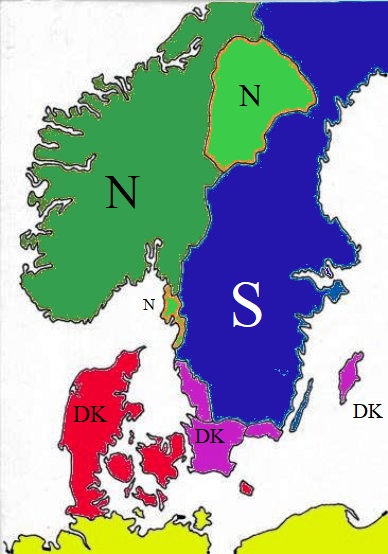
Map of Scandinavia.
The map is illustrating the situation of the borders from the Middle Ages and the radical changes in the period around 1645-1660 that determined a completely new balance in the relationship between the two kingdoms of Sweden and Denmark-Norway.
DENMARK is RED + PURPLE. Sweden conquered the purple regions Halland, Skåne, Blekinge in 1658. The island of Bornholm, part of Skåne, returned to Denmark in 1660. The purple island in the Baltic Sea, Gotland, was conquered by Sweden in 1648.
NORWAY is GREEN + LIGHT GREEN. Sweden conquered the Northern light green regions Härjedalen and Jämtland (one single area on the map) in 1645 and the Southern light green region Bohuslän in 1658.
SWEDEN is BLUE.
Nederlands, Germany, Poland are yellow.
At that time Norway was under Danish rule. Denmark and Norway remained united under the Danish kings from 1380 to 1814.
The three countries were united, for the first and only time, by the Danish Queen Margaret, a union that lasted from 1397 to 1521.
After these devastating losses about 1660, Denmark lost the Southern part of Jutland to Prussia in 1864 (partly regained in 1920).